February 19, 2026
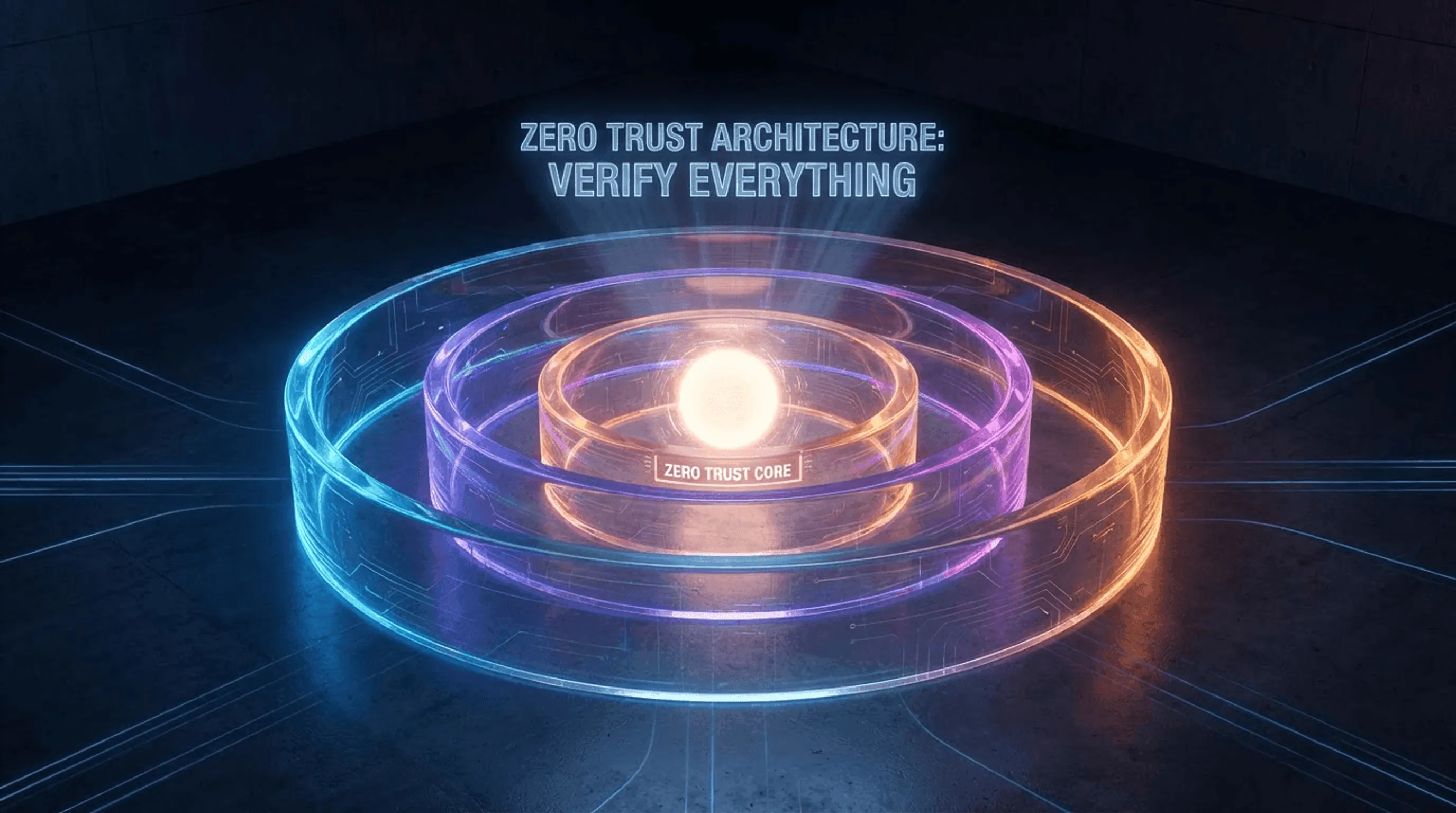
Zero Trust Architecture: Beyond the Buzzword
Zero trust is not a product you buy. It is an architecture you implement. Here is what it means for your network, users, and budget.
Zero trust has become a buzzword, but the idea underneath it is pretty simple: never trust, always verify. No user, device, or app gets automatic access just because they’re on your network or logged in before. Every access request gets checked. Every session gets validated. Here’s what that actually looks like for a real business.
TL;DR: Zero trust isn’t a single product you buy. It’s a security approach built on three ideas: least privilege access, network microsegmentation, and continuous verification. According to IBM’s 2023 Cost of a Data Breach Report, organizations with mature zero trust deployments saved an average of $1.76 million per breach compared to those without it. You don’t need to rebuild everything at once.
AdVran’s cybersecurity services include zero trust assessments as a starting point for California businesses building a stronger security posture.
What Are the Core Principles of Zero Trust?
Most breaches don’t happen because attackers broke through some impenetrable wall. They happen because someone got in through one door and then walked freely through the rest of the building. According to the Verizon 2023 Data Breach Investigations Report, 74% of breaches involve a human element, whether that’s stolen credentials, phishing, or misuse. Zero trust is designed to stop that free movement cold.
Least privilege is the first principle. Users and systems get only the access they actually need for their job. Nothing extra. An accountant doesn’t need access to your engineering files. A vendor doesn’t need access to HR records. Cutting down access like this means a compromised account causes far less damage.
Microsegmentation is the second. Instead of one big flat network where everything can talk to everything, you divide it into smaller zones. If one machine gets infected, it can’t just hop sideways to your most sensitive systems. The breach stays contained.
Continuous verification is the third. Rather than checking identity once at login and then trusting the session forever, the system keeps checking. Is the device healthy? Is the location unusual? Is the behavior suspicious? If something looks off mid-session, access gets challenged or cut.
Citation Capsule: The Verizon 2023 Data Breach Investigations Report found that 74% of breaches involve a human element such as stolen credentials or phishing. Zero trust’s continuous verification model directly addresses this pattern by challenging access throughout a session, not just at login. (Verizon DBIR, 2023)
How Do SMBs Actually Implement Zero Trust?
You don’t have to rip out your entire infrastructure. That’s the good news. The CISA Zero Trust Maturity Model, published in 2023, outlines a phased approach specifically because most organizations can’t flip a switch. Progress happens in layers over time. (CISA, 2023)
Start with identity. This is the single highest-impact step. Turn on multi-factor authentication for every account, especially email, VPN, and any cloud services. According to Microsoft’s 2023 Digital Defense Report, MFA blocks over 99% of automated account-compromise attacks. That one change alone moves the needle significantly. (Microsoft Digital Defense Report, 2023)
Next, set up conditional access policies. These are rules that say: “Only let someone log in if their device passes a health check, they’re in an expected location, and the risk score is low.” Most modern identity platforms, like Azure AD or Okta, support this out of the box. It’s not exotic technology. It’s configuration.
After that, start segmenting your network. You don’t have to do it all at once. Begin by separating your most critical systems, like your finance tools and customer data, from general employee traffic. Even basic segmentation dramatically limits how far an attacker can move if they get in. Managed network infrastructure, including SD-WAN design and segmentation, is often the fastest path to getting this right without tying up internal resources. AdVran’s network infrastructure services include SD-WAN and segmentation design that directly supports zero trust architecture.
Many SMBs working with a managed IT partner reach a meaningful level of zero trust maturity within 12 to 18 months. It doesn’t require a team of specialists. It requires a clear plan and consistent execution.
In our work with small and mid-sized businesses across California, we’ve found that the biggest barrier to zero trust adoption isn’t cost or complexity. It’s the assumption that it’s only for large enterprises. The truth is, the tools have become accessible enough that a 30-person company can run a solid zero trust setup without a full-time security team.
Citation Capsule: Microsoft’s 2023 Digital Defense Report found that multi-factor authentication blocks over 99% of automated account-compromise attacks. For SMBs starting a zero trust program, enabling MFA across all accounts is the single highest-return first step. (Microsoft Digital Defense Report, 2023)
What Does Zero Trust NOT Require?
Zero trust isn’t a product you buy off a shelf. That’s a common misconception that vendors don’t exactly rush to correct. The Forrester Research team that coined the term back in 2010 was describing a philosophy, not a product category. (Forrester Research, 2010)
You don’t need to replace every switch and firewall on day one. You don’t need a dedicated zero trust team. You don’t need to blow your annual IT budget in a single quarter. What you do need is a clear strategy, a realistic timeline, and someone who can translate the technical controls into plain business decisions.
The goal isn’t perfection. It’s meaningful risk reduction over time. Each change you make, turning on MFA, tightening access controls, segmenting a network zone, shrinks your exposure. Small, steady steps add up faster than most people expect.
One thing that often surprises business owners is that zero trust actually makes compliance easier, not harder. When every access request is logged and every policy is explicit, producing evidence for a SOC 2 or HIPAA audit becomes much less painful. The controls you build for zero trust are often the same controls the auditors are looking for.
Citation Capsule: Forrester Research, which first described the zero trust model in 2010, defined it as an architecture built on the principle of “never trust, always verify” rather than as a specific product or technology. Organizations should evaluate zero trust readiness by strategy and policy maturity, not by product count. (Forrester Research, 2010)
Frequently Asked Questions About Zero Trust
Is zero trust only for large enterprises?
No. The core principles scale to any organization size. A small business with 20 employees can implement least privilege access, MFA, and basic network segmentation without enterprise budgets. According to the 2023 Ponemon Institute SMB Cyber Resilience Report, 60% of small businesses that suffered a breach had no identity segmentation in place. (Ponemon Institute, 2023) The tools exist. The question is whether there’s a plan to use them.
How long does it take to implement zero trust?
It depends on your starting point and how much change your organization can absorb at once. A realistic timeline for a small to mid-sized business is 12 to 18 months to reach a meaningful level of maturity. That’s not a big-bang rollout. It’s a series of incremental improvements, identity first, then access policies, then segmentation.
Does zero trust replace a firewall or VPN?
Not exactly, though it does change how you use them. Traditional VPNs grant broad network access once a user connects. Zero trust replaces that model with per-application, per-session access. Firewalls still matter for perimeter control, but they’re no longer the primary defense. The identity layer takes on much more of that load.
What’s the first thing a business should do?
Turn on multi-factor authentication everywhere, today. It’s the single most impactful step and it doesn’t require a major project. According to CISA’s guidance, MFA is the foundational control that all other zero trust steps build on. (CISA Zero Trust Maturity Model, 2023) After MFA, review who has access to what and cut anything that isn’t necessary.
Can our current IT provider help with zero trust?
That depends on the provider. Zero trust implementation requires experience with identity platforms, endpoint management, and network segmentation. If your current provider hasn’t brought this up, it’s worth asking directly. At AdVran, our managed security work for California businesses regularly includes zero trust assessments as a starting point for building a stronger security posture.
What Should You Actually Do Next?
Zero trust sounds big, but the first step is small. Run an access audit: look at which accounts have access to which systems, and ask whether each one actually needs it. You’ll almost certainly find accounts that are over-privileged, old vendor accounts still active, or employees with admin rights they never use. Cutting those down costs nothing.
Then turn on MFA everywhere it isn’t already running. After that, talk to your IT team or provider about conditional access policies. Those three steps alone put you meaningfully ahead of most small businesses.
The IBM 2023 Cost of a Data Breach Report found that organizations with zero trust deployed in the early stages of a breach saved an average of $1.76 million compared to those without it. (IBM, 2023) $1.76 million in average savings per breach is a real return on a practical, incremental investment.
Zero trust isn’t about building an impenetrable fortress. It’s about making sure that when something goes wrong, the damage stays small. AdVran’s managed IT services are the operational foundation that keeps zero trust controls running consistently. Because a policy that nobody monitors is the same as no policy at all.
Related Reading
Keep reading
Related articles

The CEO's Guide to CMMC 2.0: What Every Defense Contractor Executive Must Know in 2026
CMMC 2.0 is now on most DoD contracts. This executive guide covers Level 1-3 requirements and what separates compliant contractors from those failing audits.
EDR vs MDR vs XDR: What Your Business Actually Needs
Endpoint detection, managed detection, extended detection: cutting through the acronyms to find the right security approach for your organization.

E-Rate Cybersecurity for SoCal Schools: What K-12 Districts Need to Know in 2026
California K-12 districts can offset 40-90% of cybersecurity costs through E-Rate Category 2. CIPA, FERPA, and what a compliant stack looks like.