We said the reports show the work: here's what it looks like.
This is a real incident response report, generated by the same pipeline that documents every client environment monthly. Company, computer and user names are redacted. Read it the way your auditor would.
11 pages. Prefer to talk it through? Book a strategy call or call (714) 694-4573.
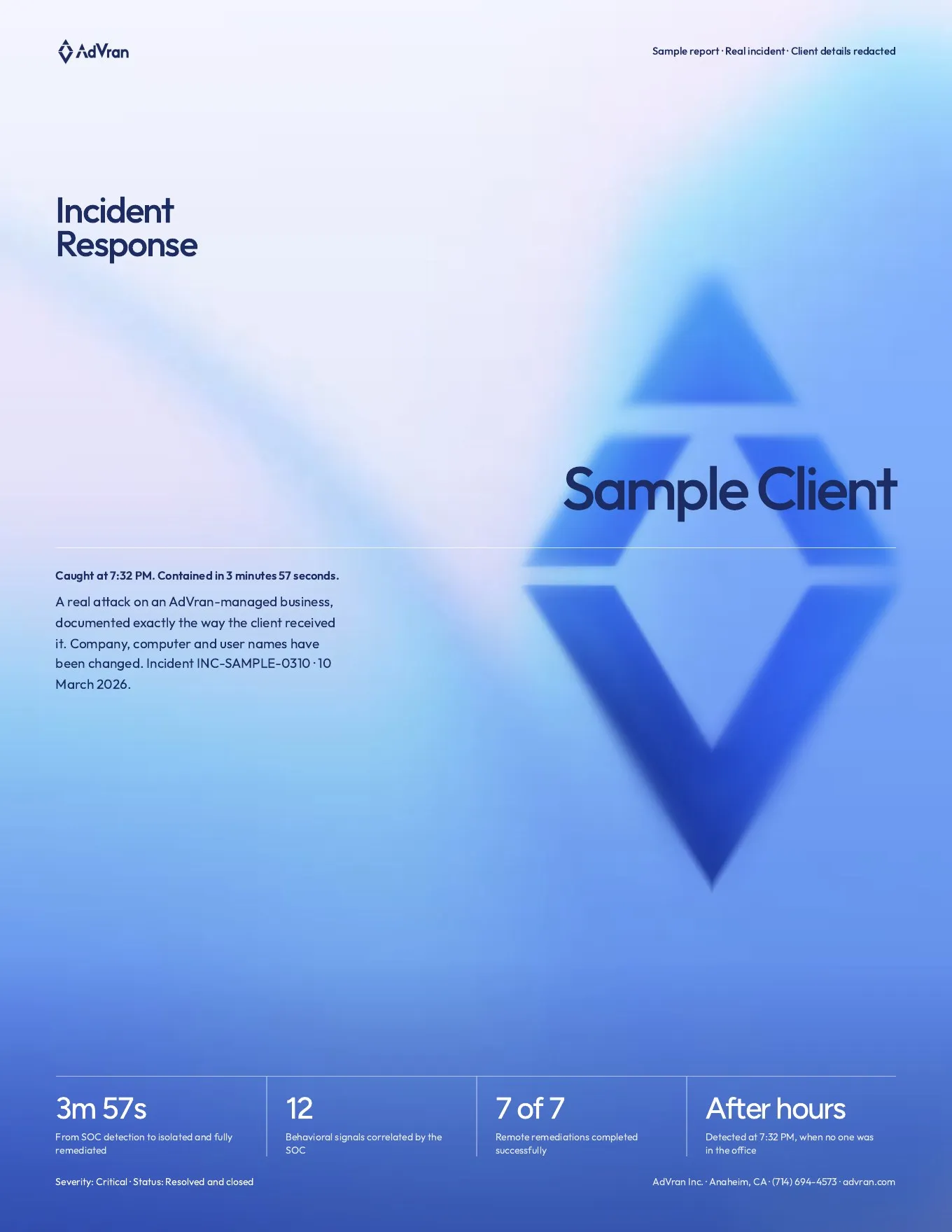
- From SOC detection to isolated and fully remediated
- 3m 57s
- Remote remediations completed
- 7 of 7
- Behavioral signals correlated
- 12
Click through all 11 pages.
Pick a page to preview it. Every one of them is exactly what the client received.
- 1CoverCaught at 7:32 PM. Contained in 3 minutes 57 seconds. The four numbers that matter, up front.
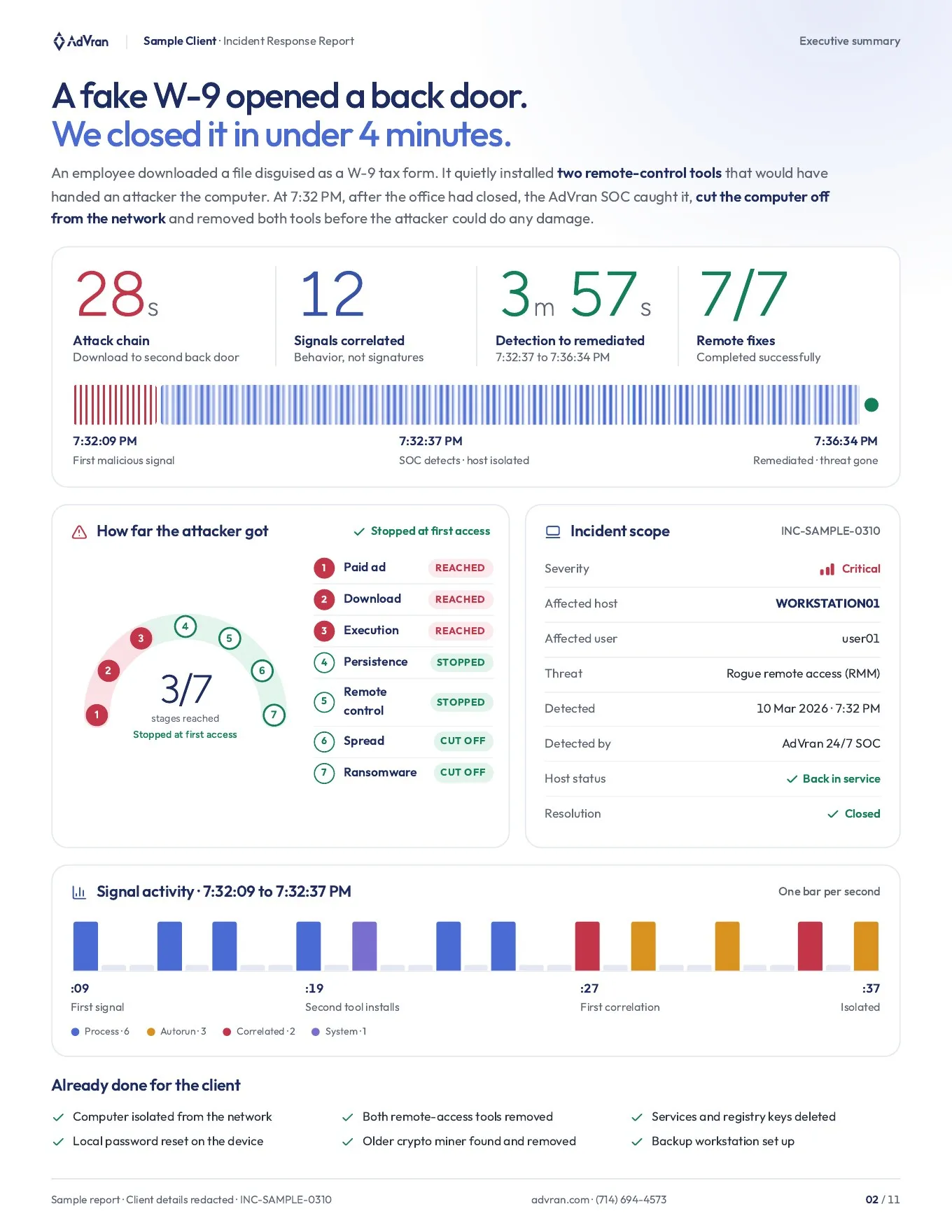
- 2Executive summaryA fake W-9 opened a back door. We closed it in under 4 minutes.
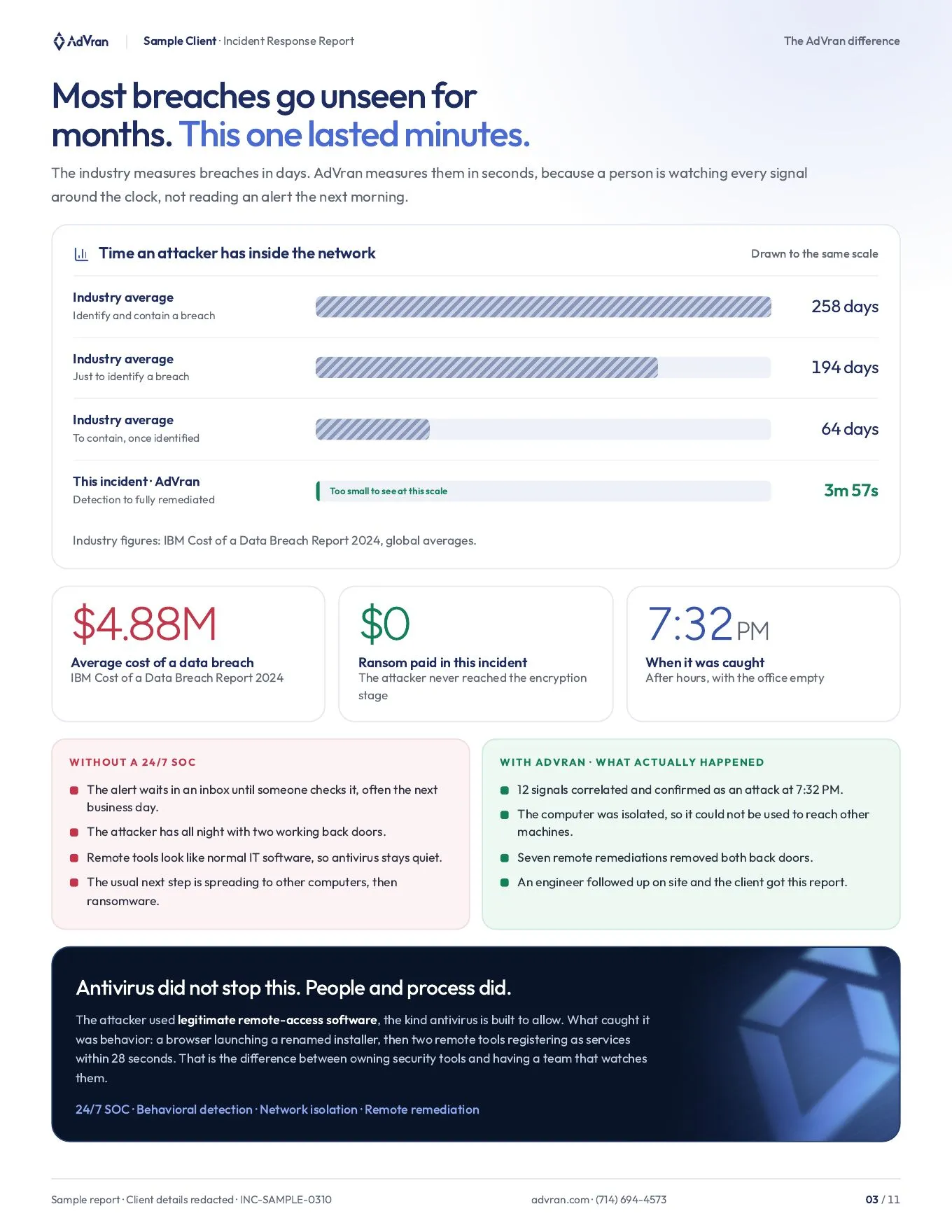
- 3The AdVran differenceMost breaches go unseen for months. This one lasted minutes.
- 4What this meansWhat happened, in the version a business owner can read in two minutes.
- 5Signal intelligenceA browser launched a renamed remote-access installer, and the SOC followed the whole process chain.
- 6Signals investigatedTwelve behavioral signals, in order of detection, between 7:32:09 and 7:32:37 PM.
- 7RemediationSeven remote actions, all completed, plus follow-ups with their status.
- 8On-site investigationHow the attack really started: not an email, a search.
- 9Incident closedRemediation complete and the computer back in service under SOC monitoring.
- 10How AdVran worksWhat stopped this attack comes with every AdVran plan.
- 11Why AdVranOne team, zero gaps: managed IT and cybersecurity under one contract.
The report is the product.
Not a feature. Not an upsell. The artifact every client gets, every month, signed.
Most MSPs send a one-page invoice and a monthly “all systems green” summary. That format exists because detailed reporting is uneconomical at their cost structure. An engineer would spend half a day producing what you just scrolled through. So the report stays vague, and the client stays in the dark about what was actually done.
We built a different cost structure. Our operations platform orchestrates the entire stack: antivirus detection, AI-based threat triage, SOC escalation to our internal team and partners Huntress and Avanan, patch management, policy enforcement, configuration hardening. Every action feeds an automated documentation layer. The marginal cost of transparency is close to zero, so we deliver it in full.
The incident above: a client's employee downloaded a malicious file disguised as a W-9 tax form. Our systems detected the threat, isolated the machine, and remediated the attack in under four minutes. Client details are redacted. Every other detail is exactly what was delivered.
Every action our platform executed on your environment.
Each item is timestamped, categorized by severity, and signed off by the lead engineer on your account. The full monthly report typically runs 15 to 20 pages; incident reports like this one arrive as soon as the incident is remediated.
Threats detected and triaged
Every detection from antivirus, triaged by our AI layer, with its severity and outcome.
Escalations
Every escalation to our internal SOC or to our partners Huntress and Avanan, documented explicitly.
Patches deployed
Every patch our patch management system applied across your endpoints and servers.
Policy enforcement
Every policy enforcement action the platform took on your environment.
Configuration hardening
Every configuration change made to reduce your exposure.
Anomaly investigations
Every anomaly investigated, and what the investigation found.
Three structural advantages every other MSP has to rebuild from scratch to match.
Orchestrated stack
Antivirus, AI triage, SOC escalation to our team and to Huntress and Avanan, patch management, and policy enforcement feed one reporting layer. No vendor produces this aggregated view on its own.
Automated documentation
The pipeline renders the monthly report directly from the systems that performed the work. No engineer rewrites it. No vagueness creeps in. The marginal cost of detail is near zero.
Engineer sign-off
Every report is signed by the lead engineer on your account. The team is built on mission-critical engineering pedigree: a former Boeing engineer founded the company, and our team includes engineers from Providence Health. The name on the report is the name accountable for the work.
About the report and how it works.
Anything else? Call (714) 694-4573 or email contact@advran.com.
Every action our platform executed on your environment for the month: threats detected by antivirus and triaged by our AI layer, escalations to our internal SOC or to our partners Huntress and Avanan, patches deployed by our patch management system, policy enforcement actions, configuration hardening, and anomaly investigations. Each item is timestamped, categorized by severity, and signed off by the lead engineer on your account. The report you just viewed is a real incident response example. The full monthly report is typically 15 to 20 pages.
Most MSPs send a one-to-two page summary with SLA uptime percentages and an invoice. That format exists because producing a detailed report by hand is uneconomical. It takes hours of engineer time per client. Our reporting pipeline is automated: every tool in our stack feeds a single documentation layer that renders the client-facing PDF. Our cost structure lets us deliver detail that would bankrupt a competitor trying to produce it manually. That's why the transparency is structural, not a marketing claim.
Both, and the report documents both. Our engineers design, configure, tune, and are accountable for the automated systems that execute most actions. Antivirus, patch deployment, policy enforcement, AI-based threat triage. When something needs human judgment, our SOC team or our partners at Huntress and Avanan step in and the report documents that escalation explicitly. We show every action regardless of whether the hands that executed were human or automated, because the orchestration is our work either way.
Every month, on a fixed cadence, without the client having to ask. Incident reports, like the sample you viewed, are delivered immediately after an incident is remediated, not held for the monthly cycle. Most clients read the executive summary on the first page and then have their IT lead or compliance officer go through the detail sections. A few request custom formatting for board packets; we accommodate.
Yes. We start with a free assessment of your current environment: a network security scan, a compliance gap review, and a walkthrough of what your first monthly report would contain. Book a strategy call and an engineer will set it up.